
The Best Website Compliance Software Ends the Guesswork
John Mike ·
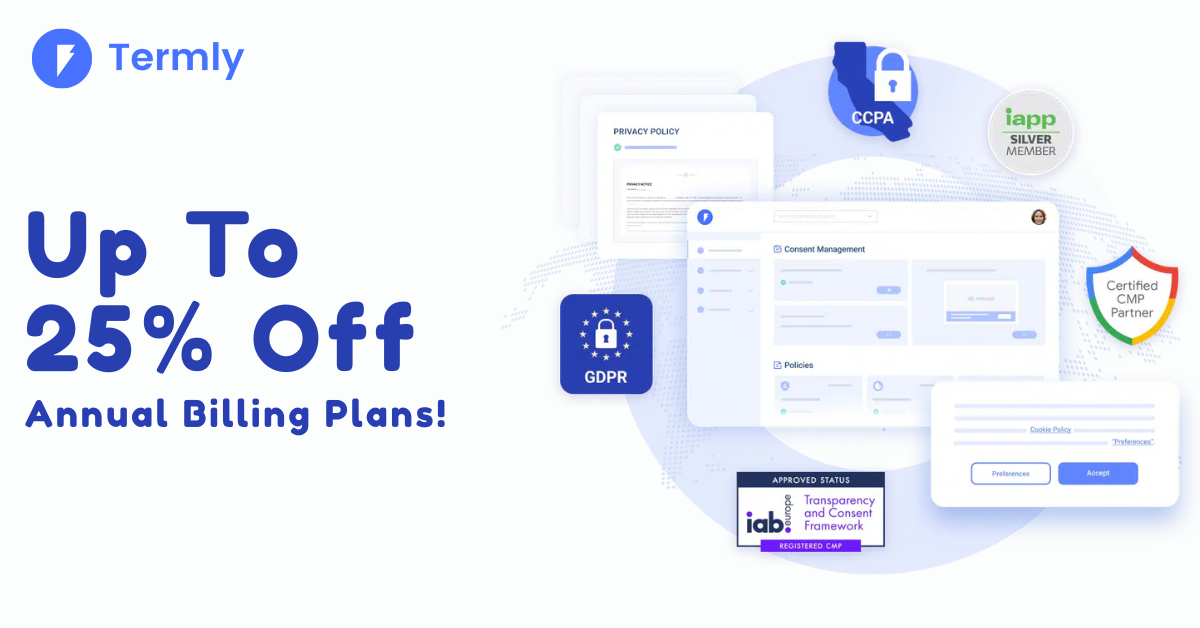
Discover why Termly is one of the best website compliance software solutions, combining privacy policies, cookie consent, and compliance tools in one easy-to-manage platform.
Running a website means juggling tasks you never signed up for. Privacy policies. Cookie banners. Consent records that shift every time a law changes.
You didn't start a business to become a compliance manager. Yet here you are, comparing website compliance software and wondering which one actually holds it all together.
This is an honest look at Termly. We'll cover what it does, who it fits, and why an all-in-one approach beats a drawer full of disconnected tools.
The Slow Pileup Most Owners Never Notice
It rarely starts with a plan. You grab a free privacy policy generator one afternoon. A cookie banner plugin the next week.
Then the tools multiply. So do the monthly charges you barely track. Each piece solves one problem while ignoring the others.
The real trouble isn't cost. It's the gaps between tools that never talk to each other.
Your cookie policy claims one thing. Your banner does another. Nobody's watching the space in between, and privacy laws live in that space.
Why Scattered Tools Fall Behind
Data privacy laws don't sit still. GDPR, CCPA, and newer rules like Quebec's Law 25 keep moving the line you're supposed to stand behind.
A standalone generator you set up last year may already be outdated. You wouldn't know until a customer, or a regulator, points it out.
That's the quiet danger of manual compliance. You're always one revision behind, patching things by hand.
The truth: the problem was never your effort. It was a setup built from mismatched parts.
One System That Works as a Whole
Termly takes the opposite path. Every tool lives under one roof and speaks the same language.
You get attorney-crafted policy generators for your privacy policy, terms, cookie policy, and more. You also get a consent management platform, a cookie scanner, and a cookie banner that matches what your policies actually say.
When laws shift, your policies update automatically. No frantic edits. No wondering whether you're current.
The takeaway: one connected system replaces a shelf of tools that never quite fit together.
What You Actually Get With Termly
Here's the practical breakdown, tied to how you'll use each piece.
- Attorney-crafted policy generators → legally grounded documents → less reliance on expensive legal fees.
- Consent management platform → automated cookie consent → alignment with GDPR and CCPA requirements.
- Cookie scanner → finds and classifies your cookies → no guesswork about what you're tracking.
- Auto-updated policies → changes applied as laws evolve → you stay current without lifting a finger.
- Google Consent Mode + IAB TCF 2.3 support → cleaner ad and analytics signals → fewer conflicts with your marketing stack.
Each feature removes a task you'd otherwise handle on your own. That's the whole point.
The Record Behind the Name
Specs tell you what a tool does. Scale tells you whether people stay.
Termly is used by more than 2 million businesses across 150+ countries. It's also a Google Certified CMP Partner with Gold status, a standard partners have to earn rather than buy.
That's not a small crowd. It's a large group of owners who chose one connected system over a pile of parts, and stuck with it.
The takeaway: when millions keep reaching for the same platform, the pattern speaks for itself.
Buying Considerations: Is Termly Right for You?
Let me be straight about the tradeoffs. No tool fits every situation cleanly.
If you run a complex enterprise with dedicated legal counsel, you may want fully custom documents. Termly is a compliance tool, not a substitute for a lawyer.
But for most websites, blogs, and ecommerce stores, it covers the essentials without the hourly firm rate. You get breadth and consistency in one place.
So who is this built for? Owners who want less cost, fewer gaps, and one dashboard instead of six.
Pros
- All-in-one suite: policies, cookies, and consent in a single place
- Attorney-crafted documents that update automatically
- Broad law coverage: GDPR, CCPA/CPRA, PIPEDA, POPIA, Law 25
- Google Certified CMP Partner with Gold status and Consent Mode support
- Free start with simple copy-paste installation
Cons
- Not a replacement for tailored legal advice
- Highly regulated enterprises may still need custom counsel
- Broad coverage means learning which tools your site truly needs
The Reason to Start Without Second-Guessing
Here's what settles it. You can begin building compliance for free.
That changes the math entirely. You're not betting a budget on a hunch. You're testing a connected system against your real site, at your own pace.
Generate a policy. Set up a cookie banner. See how the pieces fit before you commit to anything.
Ready to weigh it against your setup?
See current pricing and pick the plan that matches your site.
Frequently Asked Questions
What is website compliance software?
It's a tool that helps your site meet data privacy laws. It generates legal policies, manages cookie consent, and keeps your documents current as regulations change.
Does Termly cover both GDPR and CCPA?
Yes. Termly supports GDPR, CCPA/CPRA, and many other privacy laws. Its consent tools and policies are designed to align with each framework's requirements.
Is Termly free to use?
Termly offers a free start, so you can generate policies and set up consent tools before paying. Paid plans add broader features and coverage.
Is Termly a substitute for a lawyer?
No. Termly is a compliance tool with attorney-crafted templates. It helps reduce legal costs but doesn't replace tailored legal advice for complex cases.
How hard is Termly to install?
It's simple. Once you create a policy or cookie banner, you copy a link or code snippet onto your site. Termly handles the updates from there.
Can website compliance software handle DSAR requests?
Yes. A consent management platform can help you organize and respond to data subject access requests, so you're ready when someone asks for their data.
Conclusion
Compliance shouldn't feel like managing a toolbox that argues with itself. One connected system does what scattered tools cannot.
Termly brings your policies, cookies, and consent together, then keeps them current for you. That means less cost, fewer blind spots, and more room to run your business.